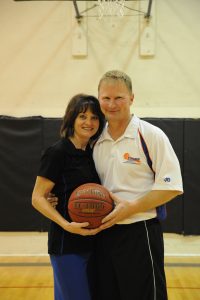
Coach Fisher has coached at the youth and high school levels for over 20 years, and is a member of the Kansas Basketball Coaches Association (KBCA) and a founding member of the National Basketball Shooters Association (NBSA).
His technical approach to shooting is based on recent research, and incorporates a physics-based approach to aid players in developing a “shooter’s touch”.
More from Coach Fisher…
The information I have learned is derived from a number of sources. Through the years, I have studied every book and video about basketball shooting that I could get my hands on. More recently, I have explored areas outside the basketball arena.
For example, the Journal of Sports Science and Medicine, Pub Med, and other scientific journals have published articles, which provide valuable insight into biomechanics. There have also been numerous basketball experiments conducted by Dr. Joan Vickers of the University of Calgary, Dr. Raoul Oudejans, and R.F.de Oliveira of the Netherlands, among others. These experiments prove that perception awareness can be improved, resulting in better performance. “Brain Training for Runners” , “The Talent Code”, “In Pursuit of Excellence”, “Perception, Cognition, and Decision Training”, and the “Physics of Basketball” are recent books which provided me with a great deal of pertinent information.
In particular, Dr.John Fontanella’s “THE PHYSICS OF BASKETBALL” had a profound influence on my thinking. Professor Fontanella applied physics to the flight of the ball and calculated the exact launch angle of the free throw for players of different height. His approach changed my perspective on shooting. From then on, I approached shooting as a problem to be solved…i.e., ‘how do we consistently send a symmetrical sphere in a straight line’? I struggled with this question for over a year before discovering the answer. It came down to some simple physics. To send the ball straight we need to apply an even force to the curvature of the ball. The real key is matching the force applied with the appropriate release method.
Once I learned this, my free throw percentage went from 80% to over 90%…using four different shooting methods! I was (and continue to be) amazed at how well this information works. Everyone is skeptical at first…but once they shoot using these techniques and see the results they become instant believers. People can miss the importance of this information if they simply watch the video. You must try it out yourself to grasp how dramatically it can improve your shot.
Ted St. Martin and Dr. Tom Amberry were two of the all-time best free throw shooters in the world. I have been blessed with their friendship and counsel. Their encouragement and direction has been invaluable. They are both outstanding role models and great people.
Both of these men encouraged me to go for a record. When they suggested it, my first reaction was surprise…it did not seem possible. I was 52 years old and was never a star player (11 points per game in high school). In track, I was always right in front of the guy who finished dead last. In other words, athletically I was on the bottom side of average.
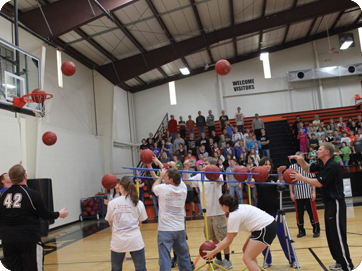
However, in September 2009, I started hitting the gym for an hour or two almost every day. After a month, I was making over 100 free throws in a row. After two months, I hit 246. At this point, I set a goal to break the record for most free throws in one minute. I broke this record on January 9, 2010 with 50. Within the next two years, I set 12 more Guinness World Records (TM) in free throw shooting. I detail the key concepts which helped me achieve these goals in a presentation titled; “How To Go From Slightly ‘Below Average’ to Guinness World Record (TM) Holder.” To schedule me, please call 785-799-5651.